

Suspension is an essential component of a car that keeps it balanced over uneven terrain. A car may roll off unexpectedly when traveling at a high speed due to sudden shock. In such cases, suspensions protect vehicles. They also provide a pleasant ride for passengers on any road, including off-road.
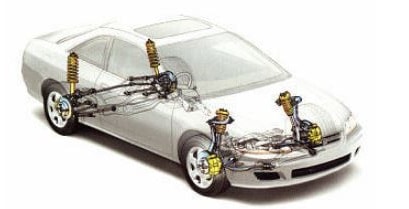
The automobile vehicle's frame and body are mounted on the front and rear axle not directly but through springs and shock absorbers. This is done to reduce shock transmission from the road. The components that work together to accomplish this are referred to as a suspension system.
Thus, the suspension system includes springs, shock absorbers, and their mountings. The suspension system of a motor vehicle is divided into rear-end suspension and front-end suspension.
Parts of a Suspension System
The following are the main parts of a suspension system:
#1 Springs
The primary purpose of springs is to retain kinetic energy. Their length and material are the primary factors that determine how much energy they can store. There are three basic types of springs that these are: air springs, coil springs, and leaf springs.
#2 Dampers
They transform the kinetic energy held in the springs into thermal energy and are also referred to as shock absorbers.
They are found in the space between the wheels of a car and frame. The lower part of the dampers attaches to the wheels, while the higher part attaches to the vehicle.
#3 Anti-Roll Bar
It is a metal bar that joins the two suspension components and keeps the vehicle from sliding off during turning.
#4 Struts
It is composed of springs and a damper.